
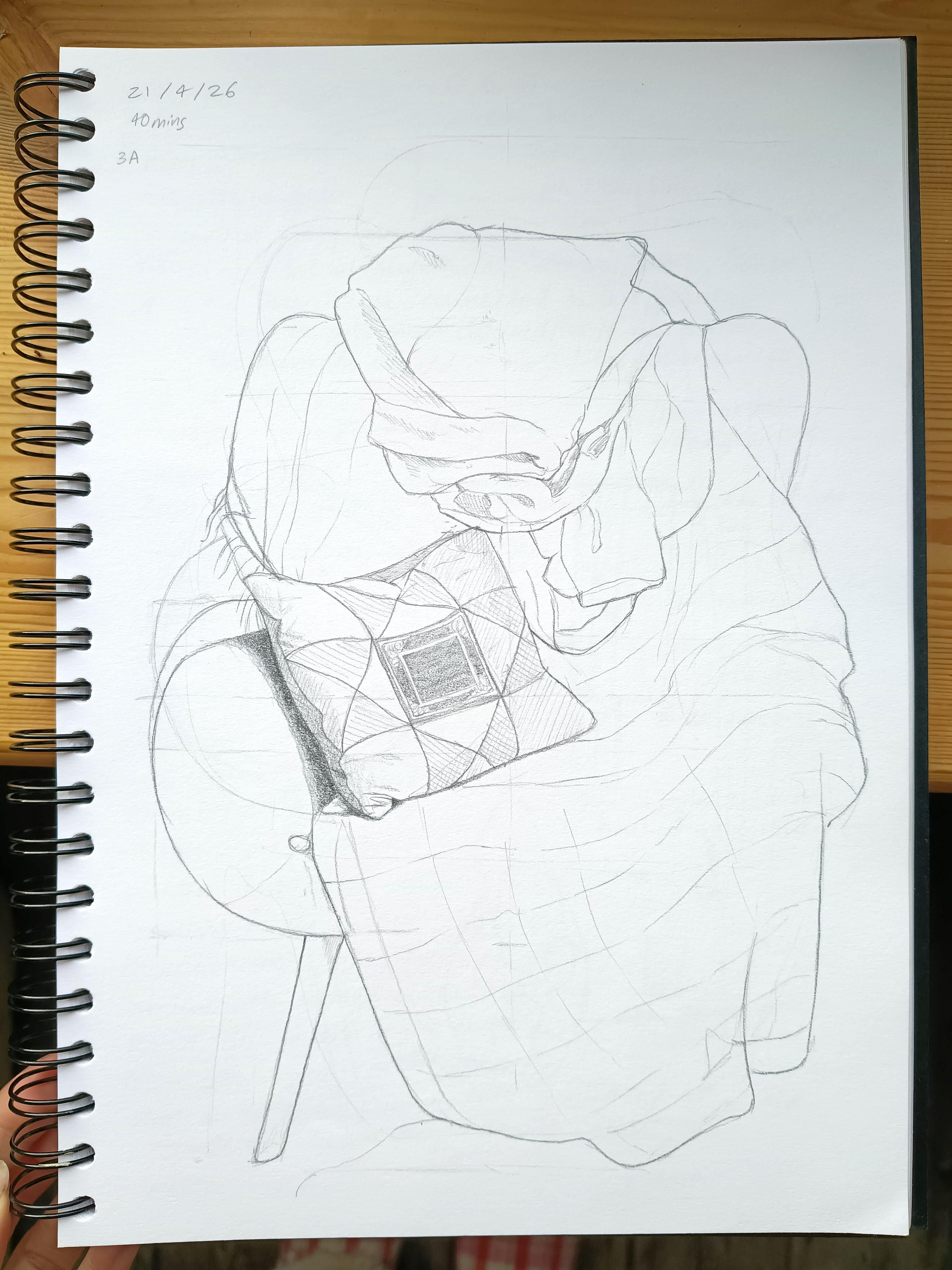
Recently, I’ve noticed my sketchbook drawings aren’t quite where I want them to be in terms of confidence and accuracy, so I decided to refresh my learning. I borrowed Keys to Drawing by Bert Dodson from my local library, and started approaching it like a self-directed art course. It still feels surprisingly free, and the tone is very calm and practical. Dodson reads as a patient teacher, rather than strict step-by-step instructions.
However, I quickly encountered a problem. Dodson suggests asking a friend to pose, and I don’t really have anyone who can sit still for half an hour! Life drawing classes aren’t accessible to me, either. What do I do in the situation?
Drawing from photos didn’t feel like the answer. It’s too easy to copy shapes without really seeing, and the results can feel flat. I wanted something that would still challenge me to observe properly. After thinking it over, I decided to draw furniture instead. I chose a chair piled with clothes and treated it like a figure. I used the techniques in the book: measuring with a pencil, finding midpoints and checking alignments.

Compared to drawing a plant or a still life, a chair gives clear feedback on whether proportions and angles are off. I realised how much I can get away with when drawing foliage, but if the legs are in the wrong place on a chair, the whole drawing looks off.
While drawing, I noticed an issue that hadn’t troubled me for some time. I had stopped using these measuring techniques years ago, because I ended up relying on them too heavily, and lost some of the liveliness of drawing, like gesture and my own personal style. However, avoiding measuring completely is probably part of the reason I’m no longer happy with my sketchbook work. By reintroducing these techniques, but using them only to inform parts of the process instead of the whole, I’m hopeful I can find the right balance.
The more I looked, the more the scene in front of me opened up and I noticed more folds and shadows. As I kept drawing, I felt tension dissolve in my brain and body, and I entered the elusive flow state, where time and worries disappear.
I set a time of 30-40 minutes, which meant leaving some part unfinished. This can be unsettling, but I’m learning to stop once my focus drops instead of forcing myself to keep going. Strangely, this has the opposite effect to what I expected; stopping early seems to improve my skills over time. I used to think pushing through the tedium was important, but it turns out I just end up creating bad habits through poor focus.
Dodson suggests following a checklist after completing the drawing, with questions such as ‘did I find the midpoint’ and ‘did I use measuring at least twice’. This has a brilliant effect of stopping the voice of judgment praising or condemning the drawing, instead treating it like a learning opportunity.
It’s not the same as life drawing, but until I can convince someone to pose for me, it’s a good way to practice observation. It’s important not to let obstacles stop you from pursuing your goals.
Leave a Reply